Author Archives: gotpapers

Marty/Radwar’s House Search

It’s hard for contemporary demosceners to imagine, but back in the 1980s, when much of the scene‘s activity evolved around pirated games, and the separation between “illegal” and “legal” scenes was far from complete,1 sceners were always conscious of the potential for unwanted contact with the police – at least in countries like Germany, where software pirates became a target for law enforcement as early as in the mid-1980s. Even those who defined themselves as “legal guys” were not completely safe from an unpleasant encounter with the police: Copyparties, potential targets for police raids, were attended by demo coders just as much as by crackers and swappers; a contact address of a musician or an intro programmer in a scrolltext could be easily mistaken by law enforcement for that of a “dangerous” pirate; and, after all, who didn’t own at least a few cracked games? Nearly everyone knew someone who was “busted” but, of course, every scener was convinced that they would not be the next. As an Amiga BBS veteran put it recently: “It was like being on the surface of the Moon: Sometimes a meteorid strikes here and there, but one still feels safe.”2 Some sceners managed to stay “unbusted” during their whole career, even while being knee-deep in the “illegal business” – but many didn’t.

Since proceedings in the 1980s against alleged and real software pirates took place in a very recent past, it’s not really possible to explore the events from the perspective of law enforcement through archival work. However, some veterans kept the documents that were handed to them in the course of investigations. We are highly indebted to Marty of the (in)famous C64 cracking group Radwar Enterprises 1941 for providing us with documents from the investigation against him in late 1989.

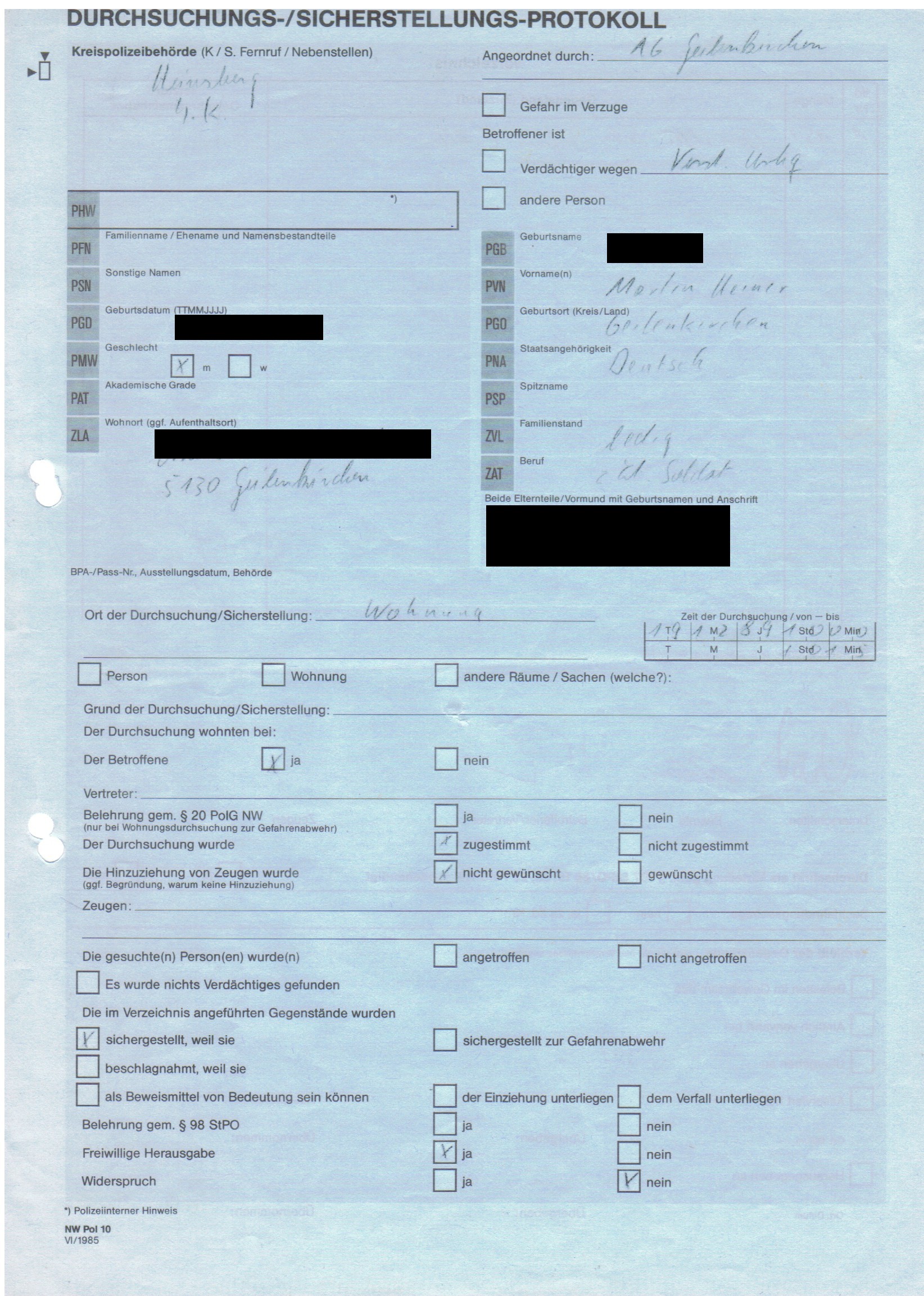
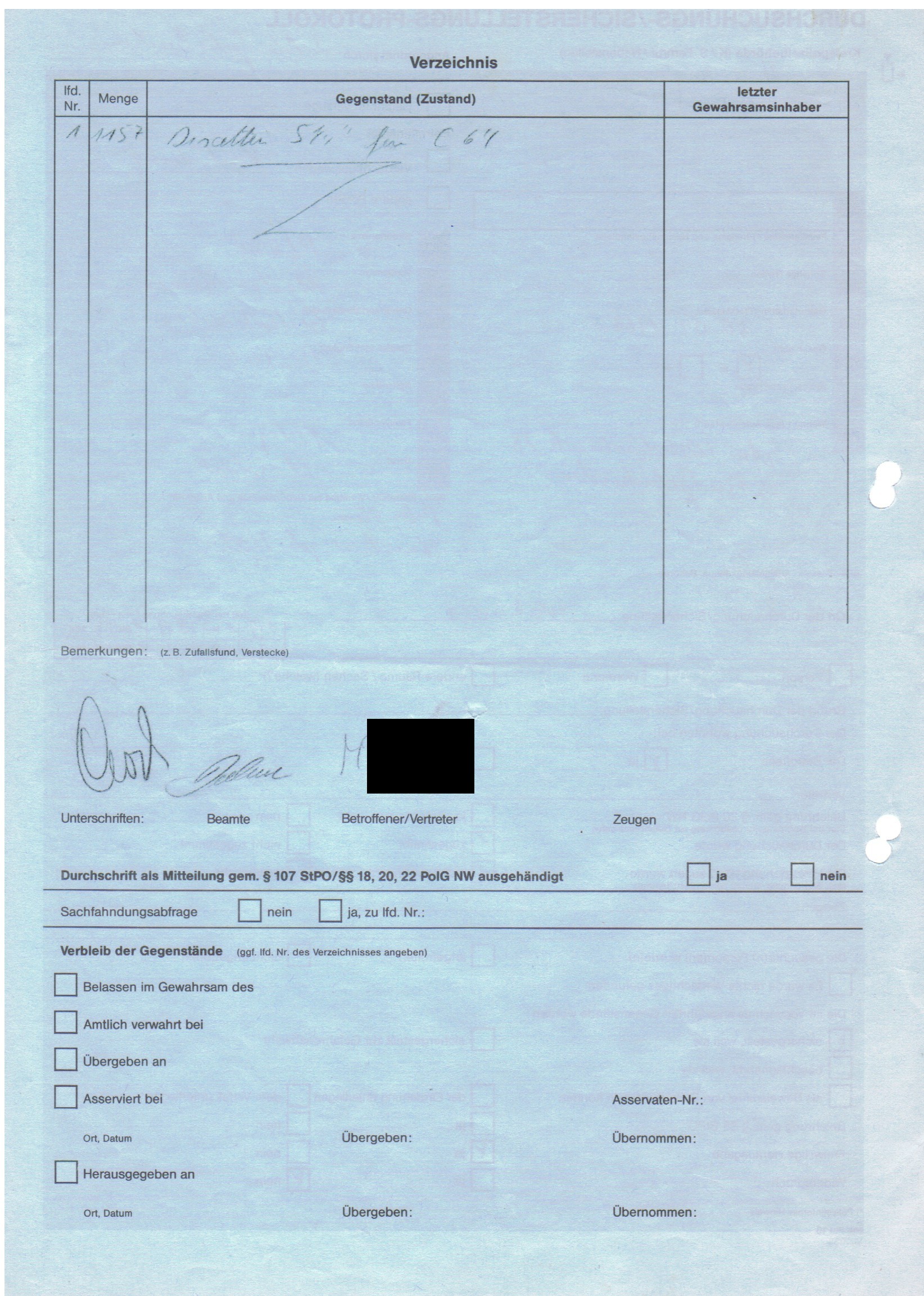
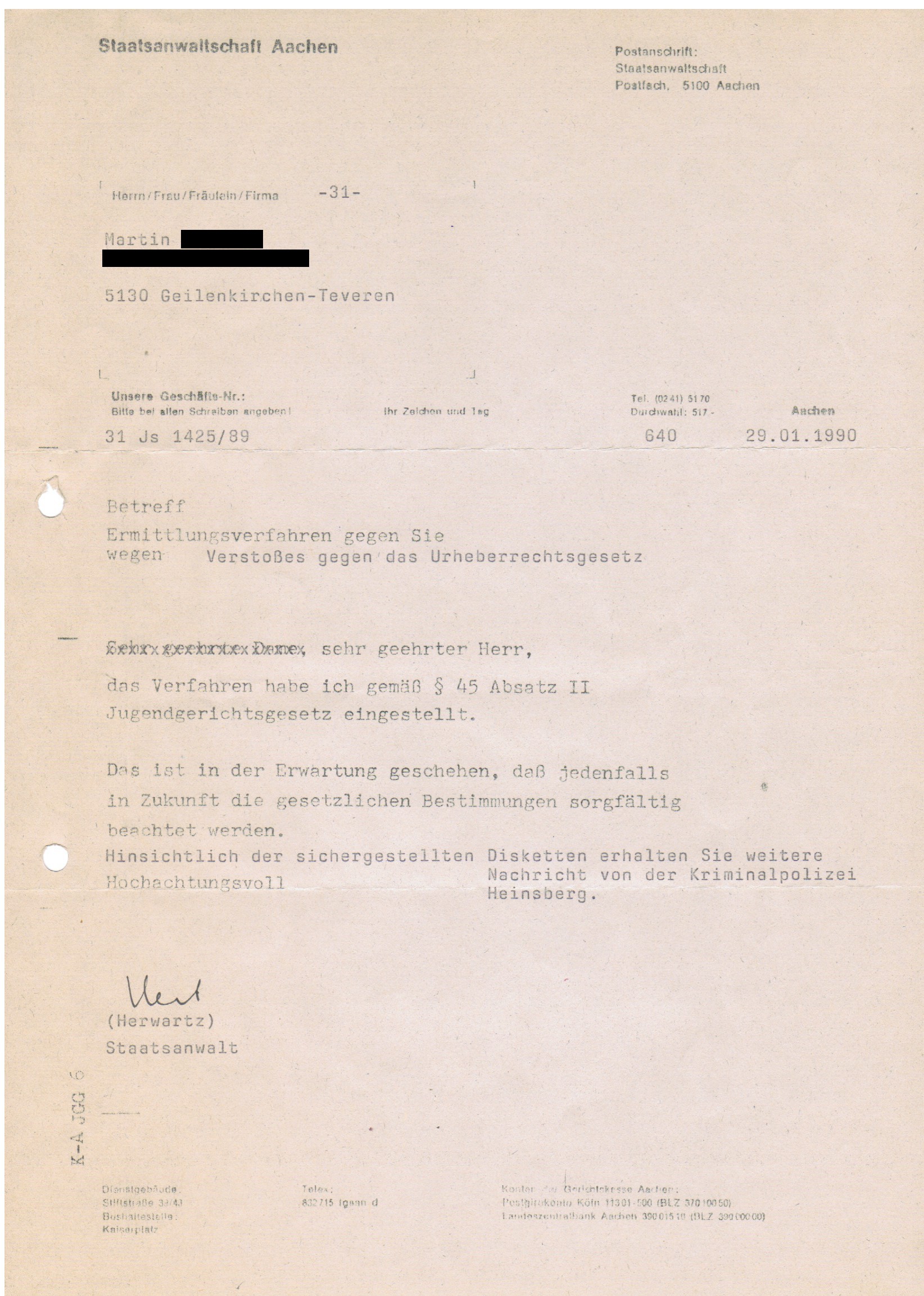
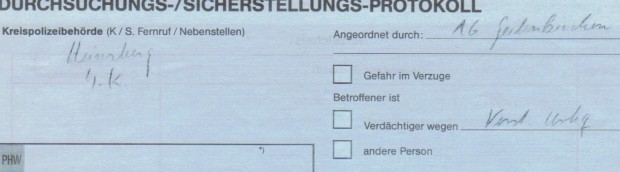
The first page is the house search warrant from 6 November 1989, issued on “suspicion of illegal circulation of copyright-protected software”. The following two pages (the ones on blue paper) constitute the protocol of the house search, which took place some two months later; the second page confirms the confiscation of 1,157 (!) C64 floppy disks. However, as it was often the case, the criminal proceedings were ceased a mere month later, in January 1990, due to the classification of the accused as a “young offender”; the corresponding resolution (page 4) expresses hope that “in the future, [the accused] will abide by the law”.

Here is Marty’s story of the whole affair:3

“In 1988, I was drafted into the army and thus sold everything from my C64 collection in order to buy a reliable car to drive to the barracks in. However, while I sold everything else – computer, disk drives, printer, books, magazines – I kept a part of my (rather large) collection of disks, about 2,000 of them. […] After getting rid of all my hardware, I also slightly distanced myself from the scene and only seldom got in touch with my Radwar mates. At that time, I had discovered the opposite sex, and that’s what preoccupied me more. […] Shortly before the house search took place, the father of my then-girlfriend brought me his C64 and a 1541II [disk drive] in order for me to upgrade his system with SpeedDOS.4 The disks which I kept were safely stored in my granny’s attic. However, in order to do some testing, I brought them back to my parents’ place. Shortly before that, I incidentally bumped into MWS [/Radwar] and he gave me his latest releases. It must have been around 100 of his disks that were confiscated together with mine in the end. Having a computer at my fingers again, the scene virus began to set in…

After I had refurbished the computer, I had to give it back, but I still kept a 1541 (which I bought for test purposes) and the disk collection at home. Then the house search took place. Superintendent Dolenz took all disks with him and left me with the 1541, since I couldn’t do anything illegal with it. During the house search I got to know that there had been a bust in the Ruhr area during which my address was found in an address book. I assume that it was the house search at Jeff Smart’s place, since they indeed found his address book,5 so I got caught up in that.

The criminal proceedings took their course, and I had to come to the police station and give a statement. The police must have noticed that MWS’s disks were encrypted with COP-SHOCKER, because they asked me for the “decryption sequence”, but I didn’t tell them anything because I didn’t want to incriminate myself.6 However, they seemed to have forgotten about the encryption in the course of the proceedings, since I was never again asked about it. […] Anyway, the case went through the system for a few weeks, and, probably since they found only disks and no further evidence of any commercial business with cracked software, the criminal proceedings were ceased in the end. I even got some of the disks back, namely those protected with COP-SHOCKER and those which were empty or unreadable. I think I got around 300 disks back.”

You can download high quality scans of Marty’s documents here.

PS: Thanks to Syphus for late-night proofreading!
C64 Disk Covers (Fzool Collection #3)

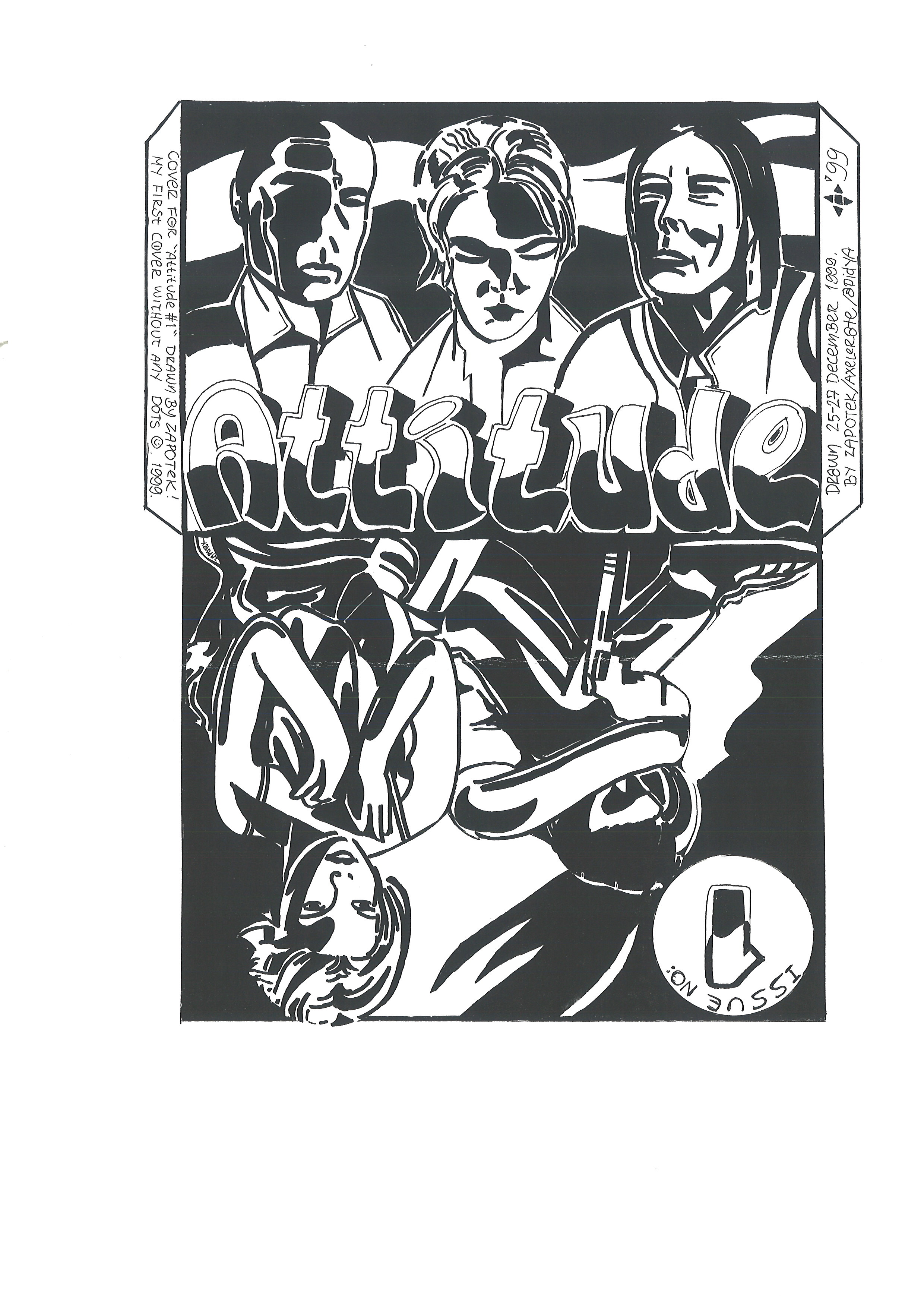
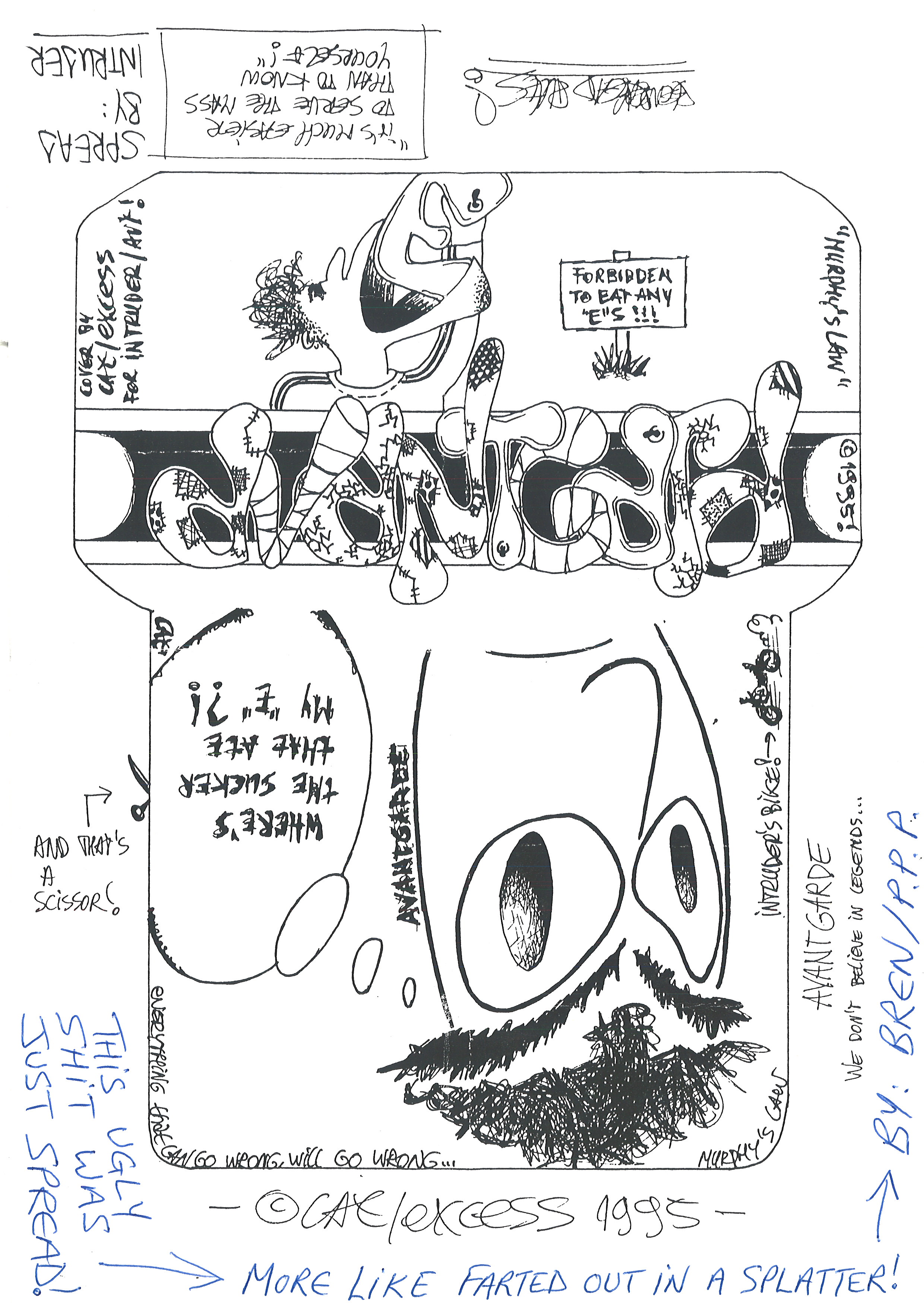
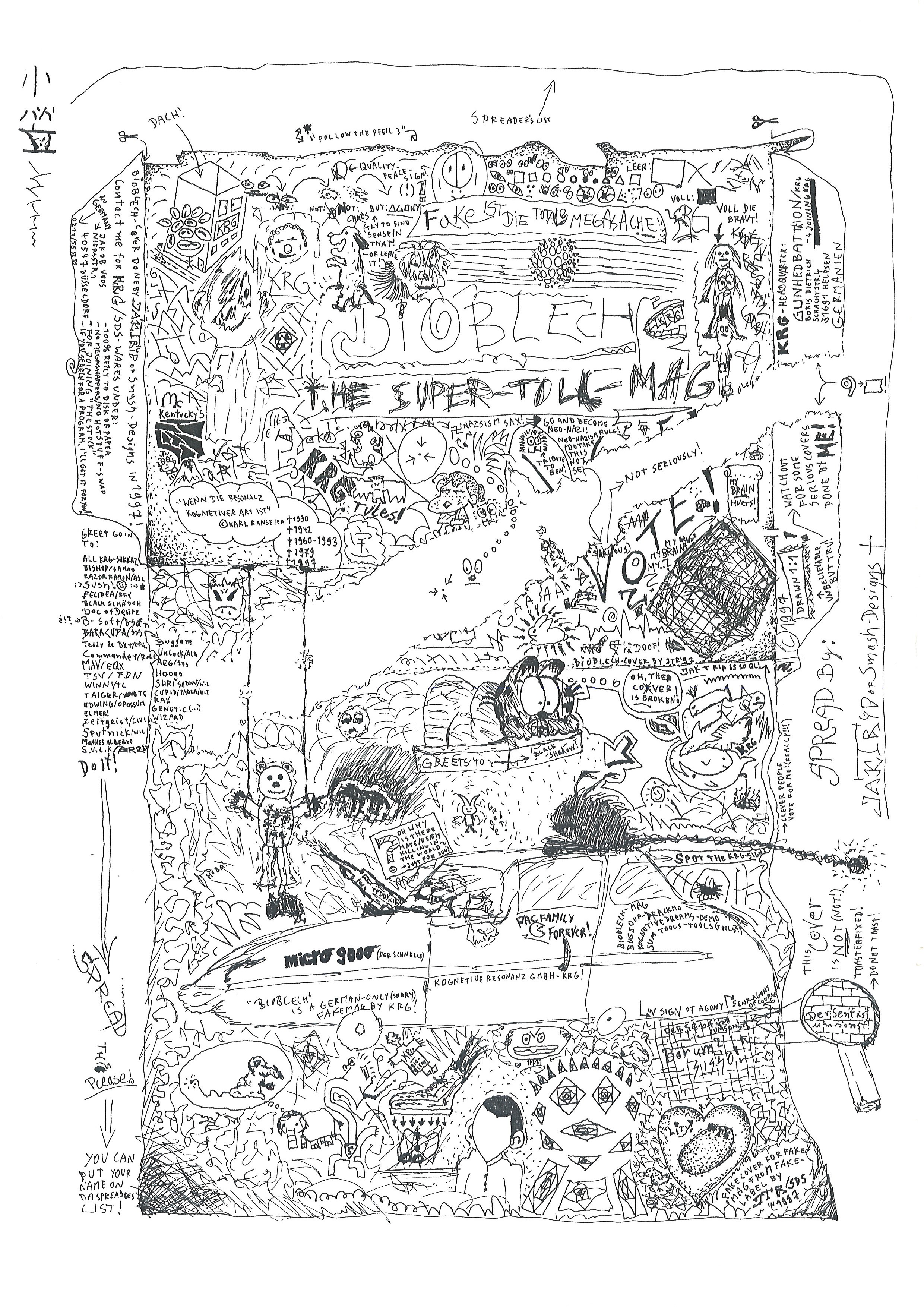
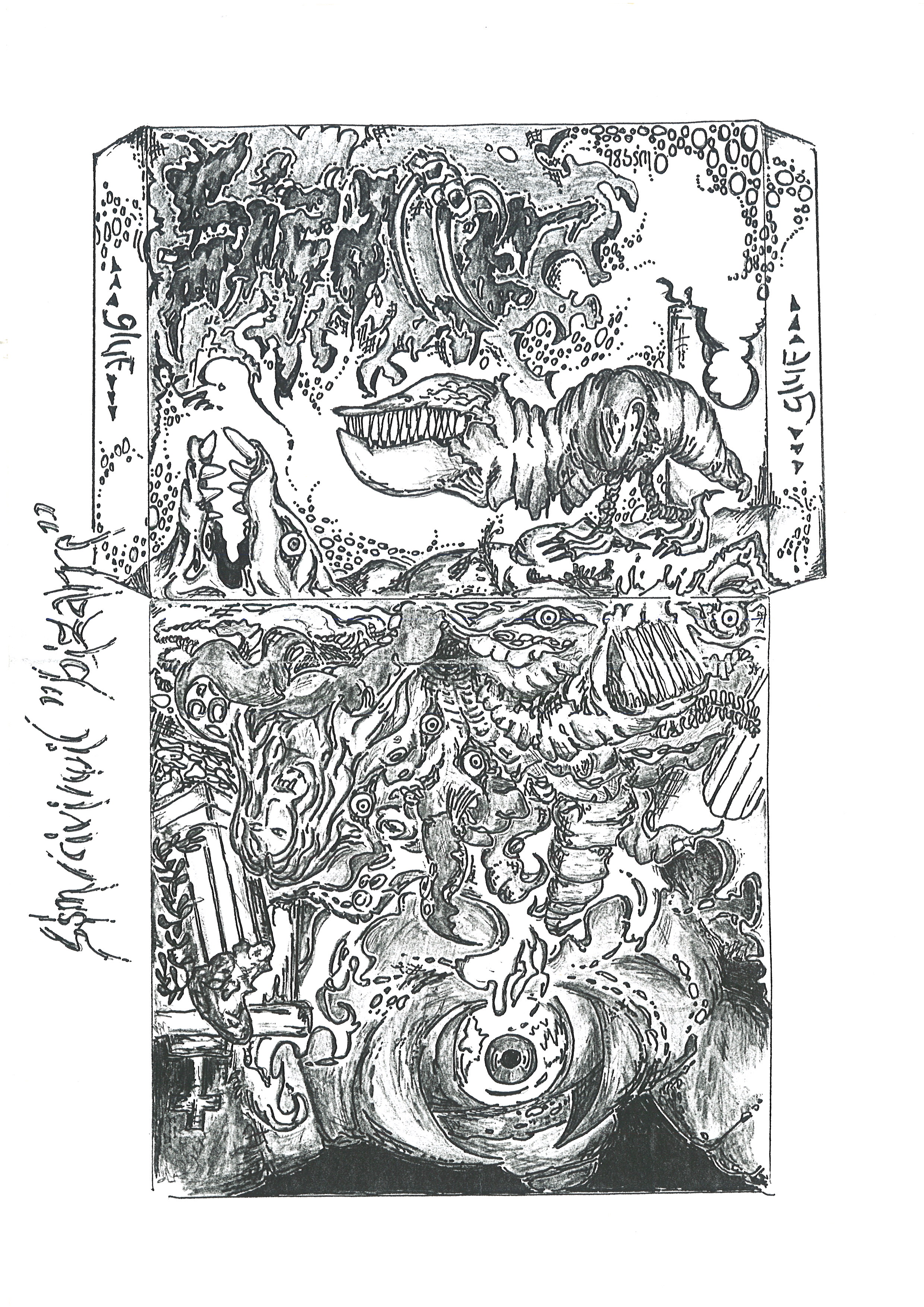
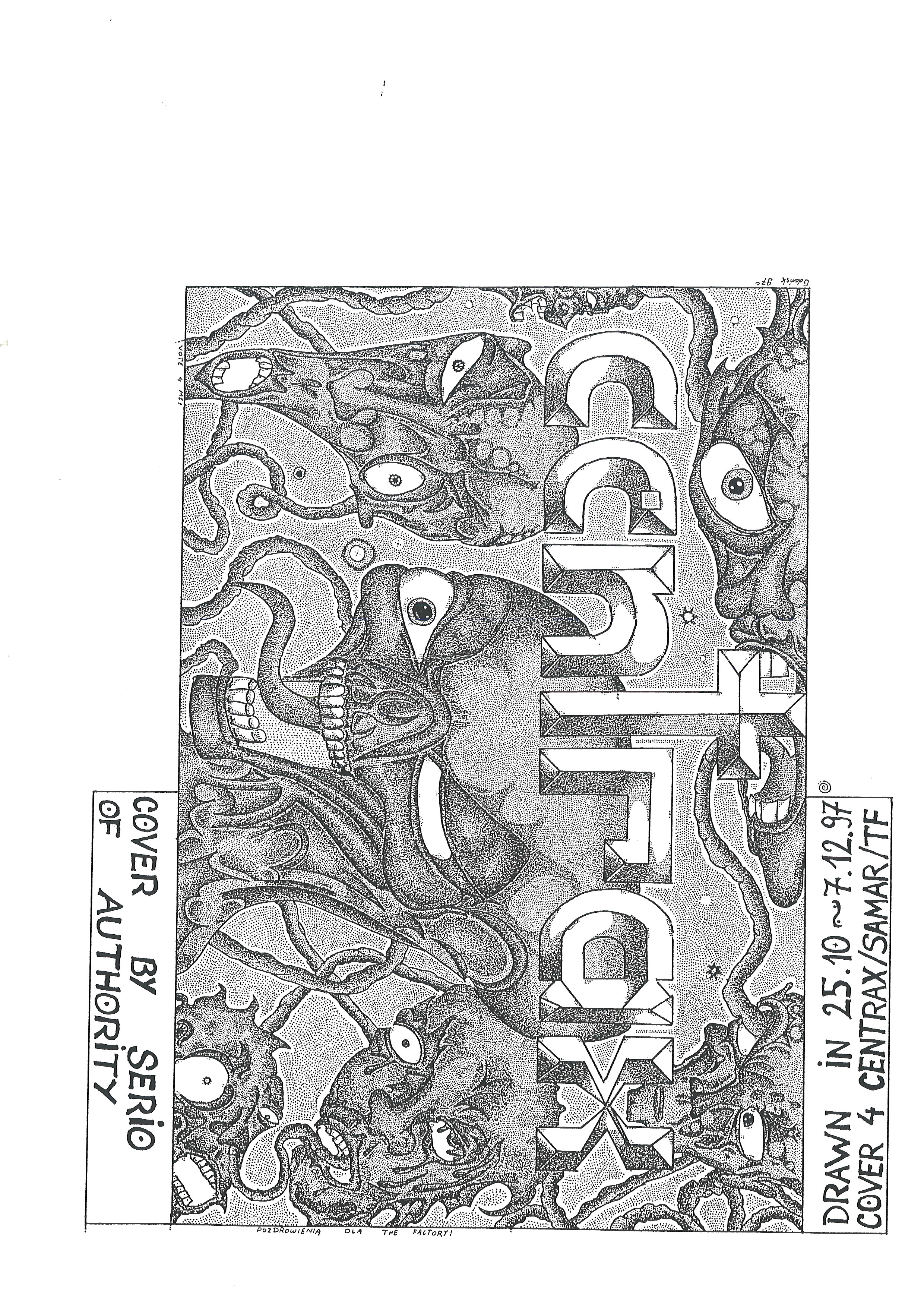
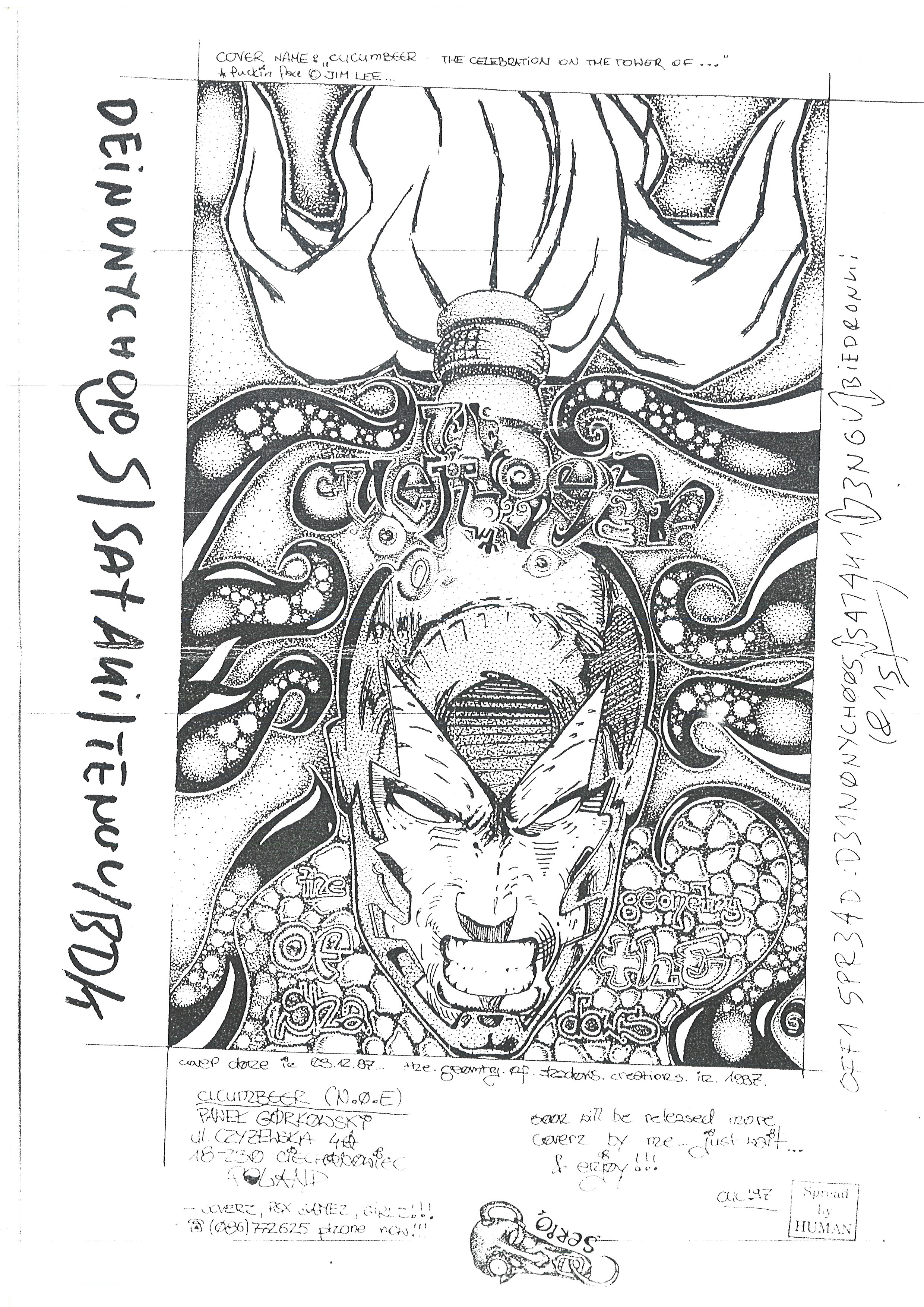
Here we go with another portion of Fzool‘s vast collection of paper artifacts from the mid-1990s C64 demoscene. This time it’s disk covers – used to store 5,25″ floppy disks, but also exchanged among sceners as a commodity of its own, as can be seen with these covers, copied on A4 sheets and “swapped” by sceners without actually cutting them out. “Cover designer” was a proper scene “profession” at that time, and there are a few stunning pieces of work among these covers.

Attitude #1 disk cover by Zapotek, 1999 [metadata]
Avantgarde disk cover by Cat, 1995 [metadata]
Bioblech disk cover by Jak T Rip, 1997-1998 [metadata]
Bizarre disk cover by Brainsmasher, 1998 [metadata]
Centrax disk cover by Serio, 1997 [metadata]
Colitt/De-Koder disk cover by Zapotek, 1999 [metadata]
Cucumbeer disk cover by Serio, 1997 [metadata]
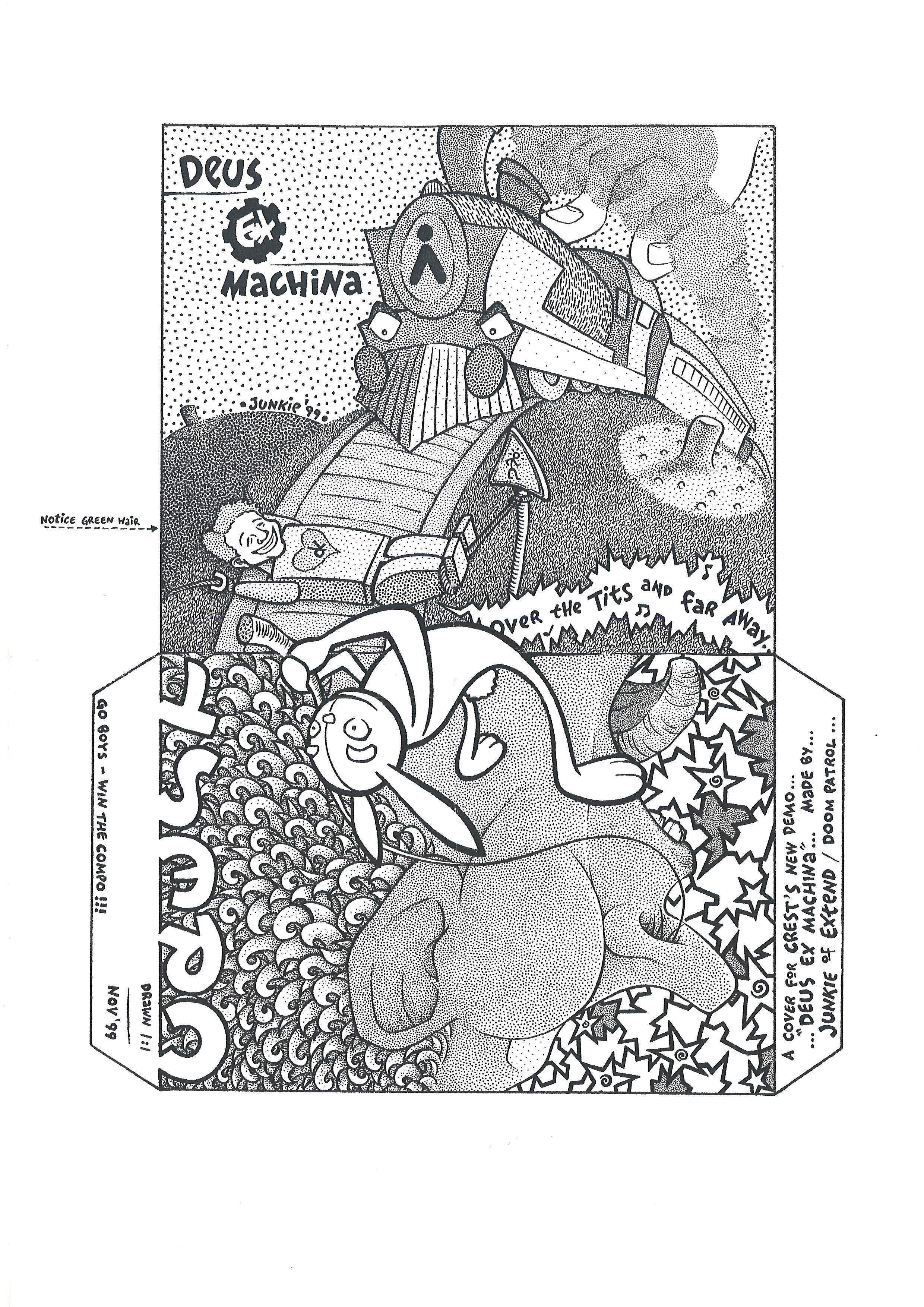
Deus Ex Machina disk cover by Junkie, 1999 [metadata]
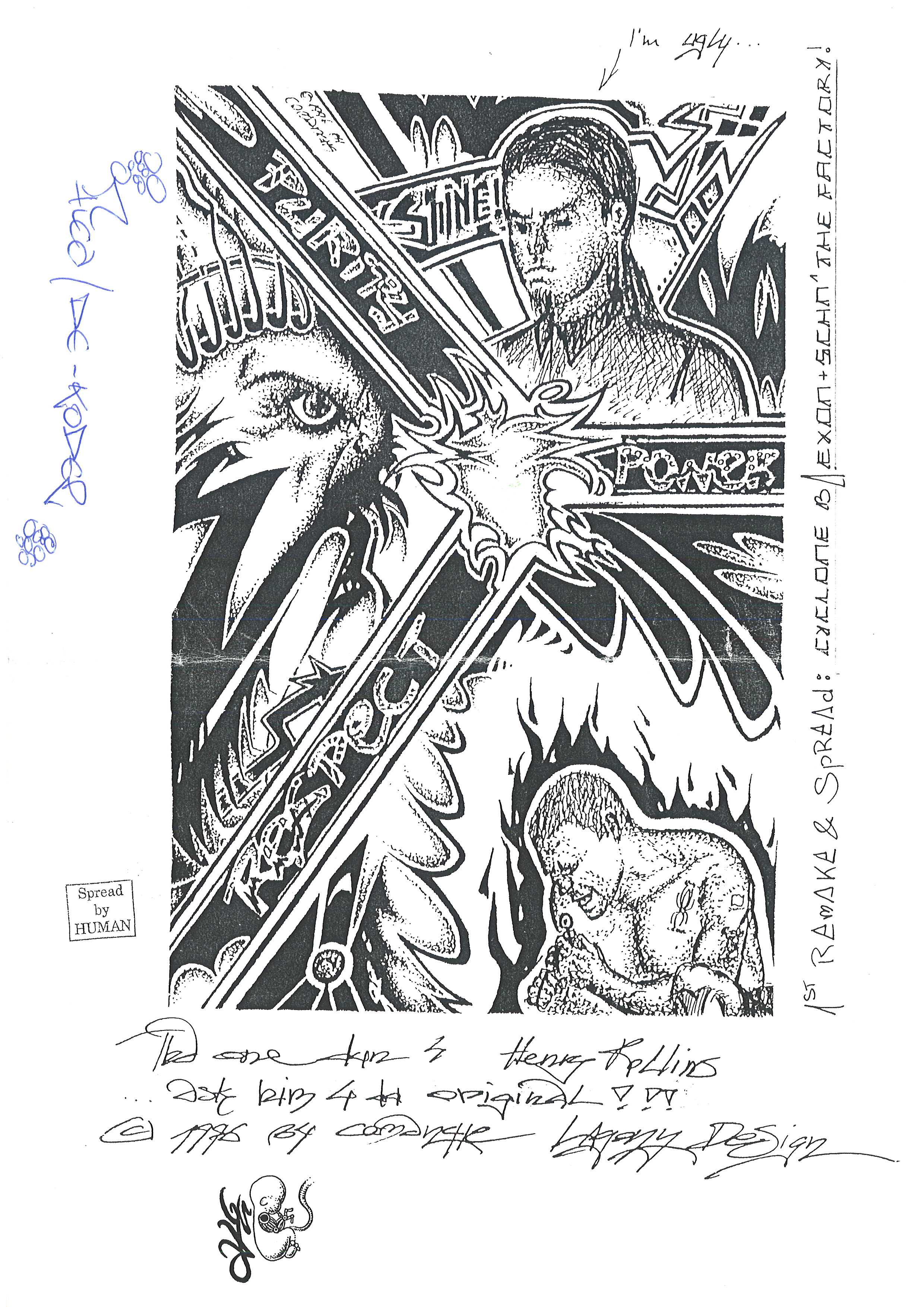
• Untitled disk cover by Comanche, 1995 [metadata]
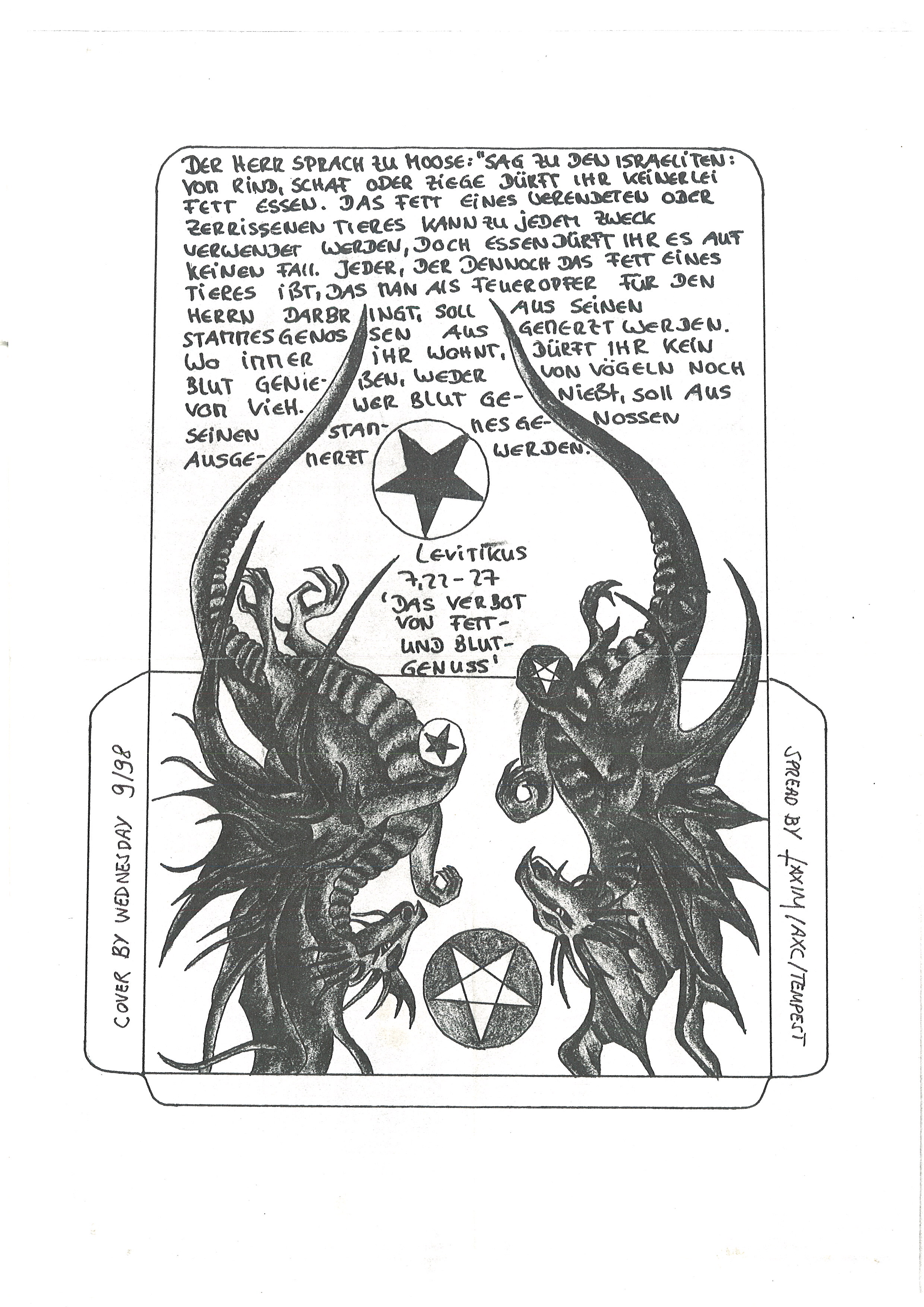
• Untitled disk cover by Wednesday, 1998 [metadata]

Mixed Demoscene Stuff From Se7en

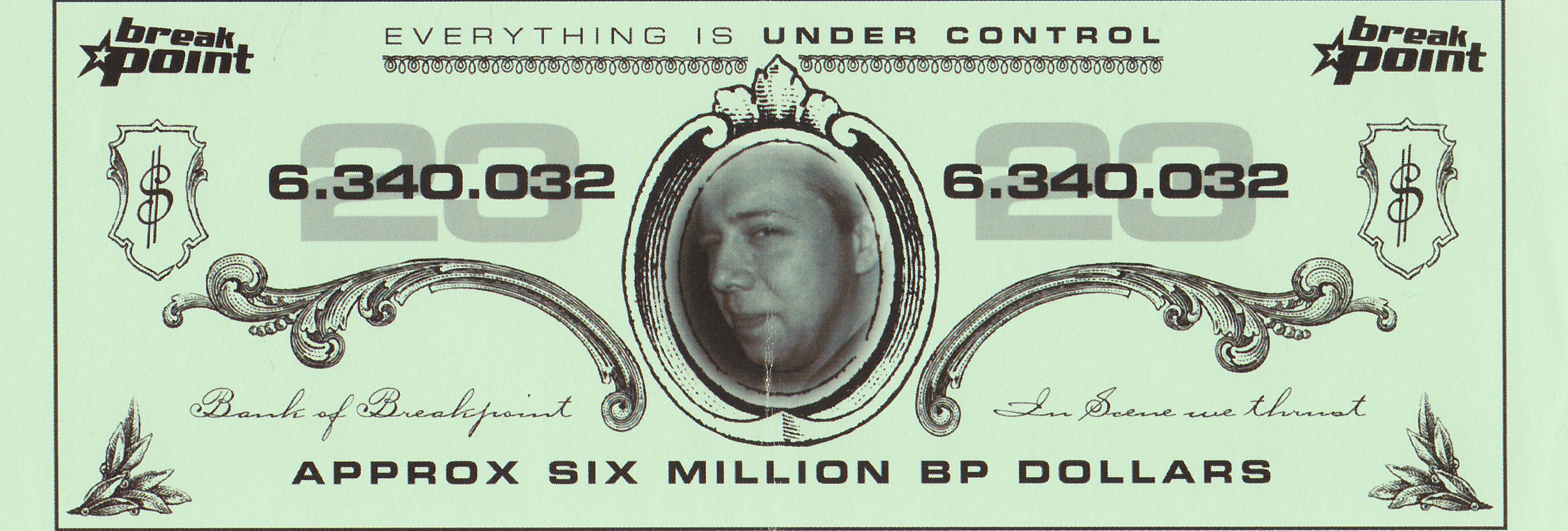
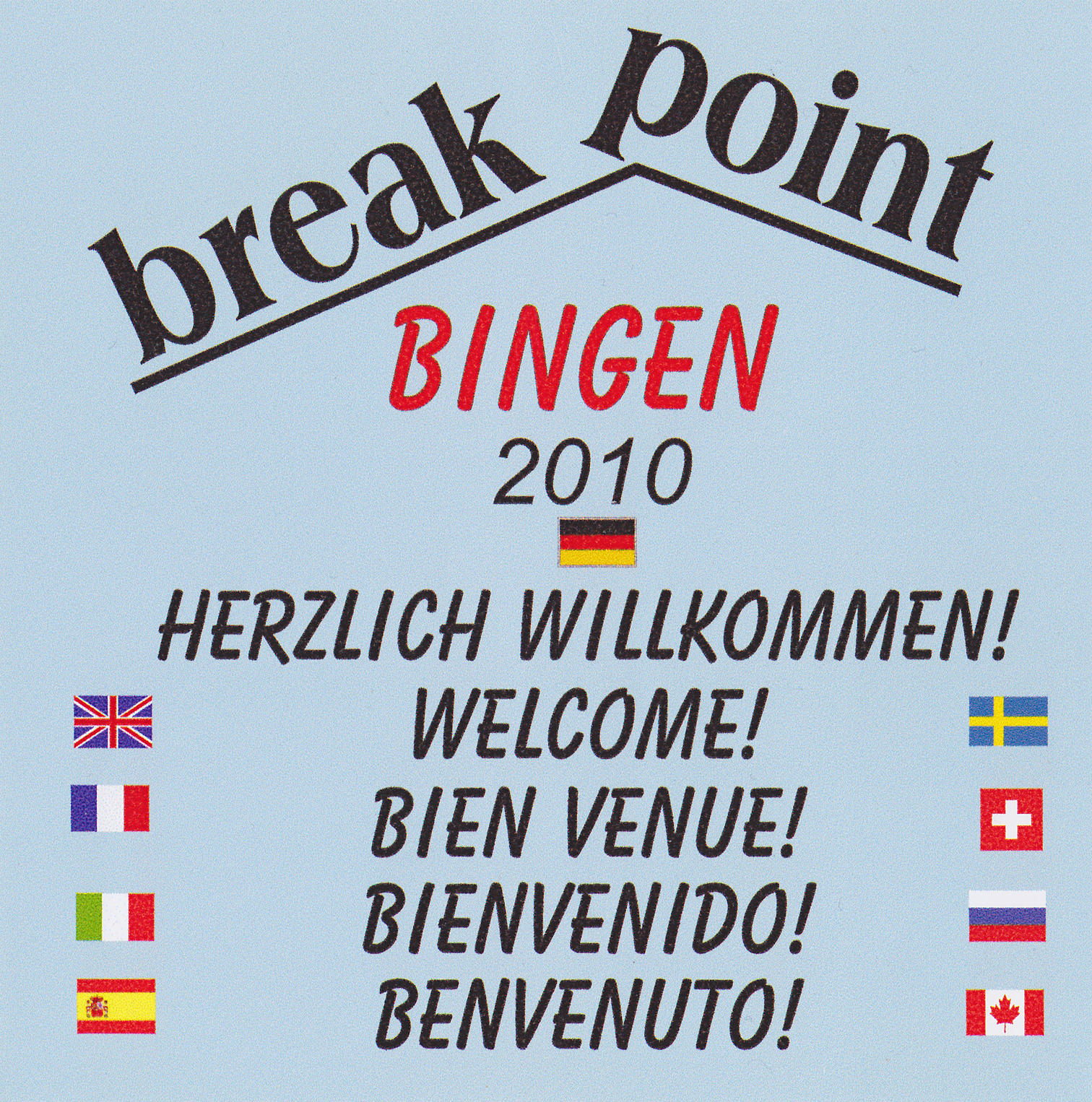
Once again, Se7en scanned some things which he accumulated during his long-standing demoscene career: Stickers, disk covers, flyers, and some weirder things like “demoparty dollars” and a Breakpoint sticker produced by a hotel. Enjoy!

Birdhouse Projects sticker, 2000s [metadata]
Brainfart “Prost!” sticker, 2000s [metadata]
Breakpoint 2009 dollars [metadata]
Breakpoint 2010 hotel sticker [metadata]
Crest “Deus Ex Machina” sticker, 2000 [metadata]
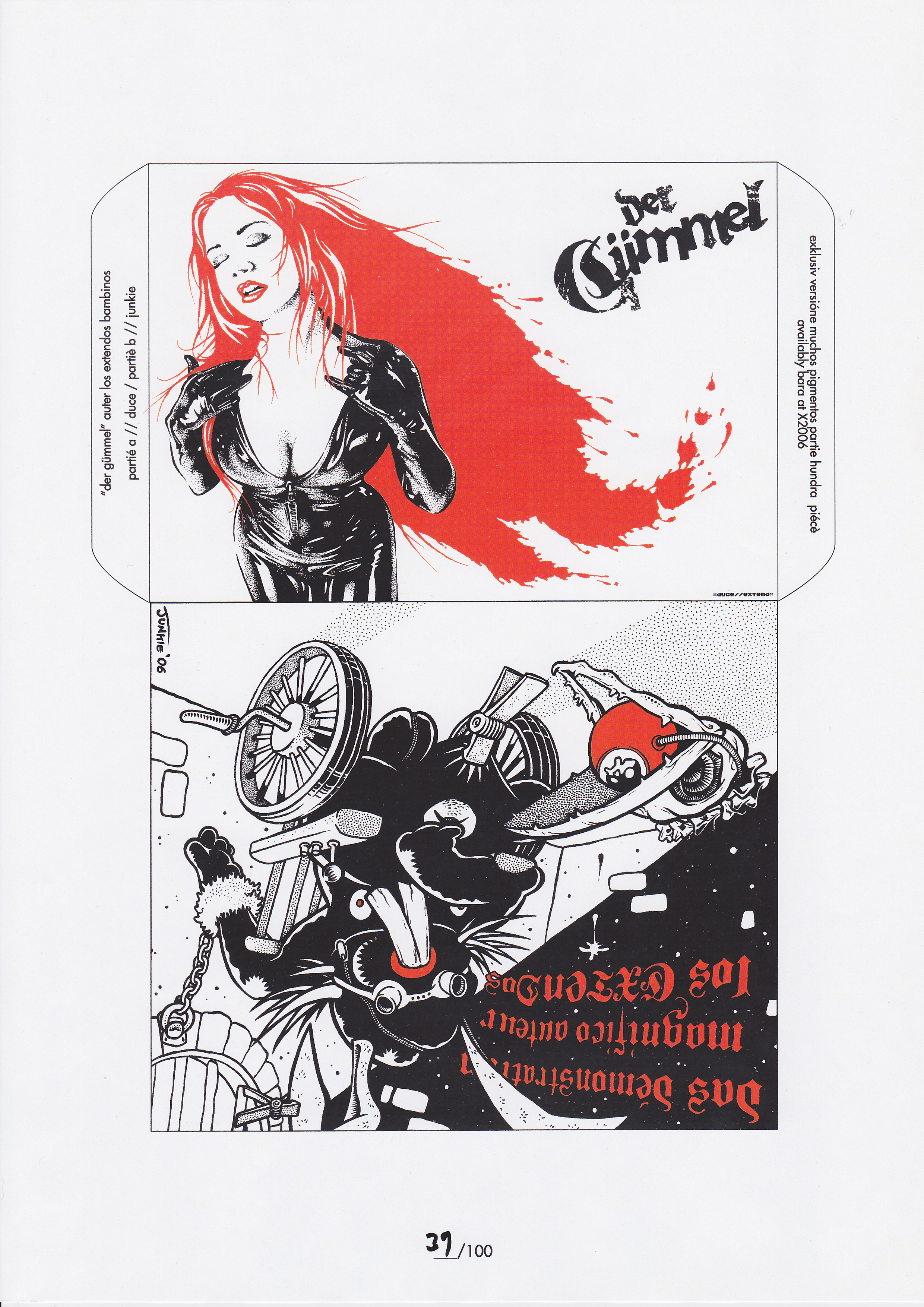
• Disk cover for Extend‘s “Der Gümmel” demo, 2006 [metadata]
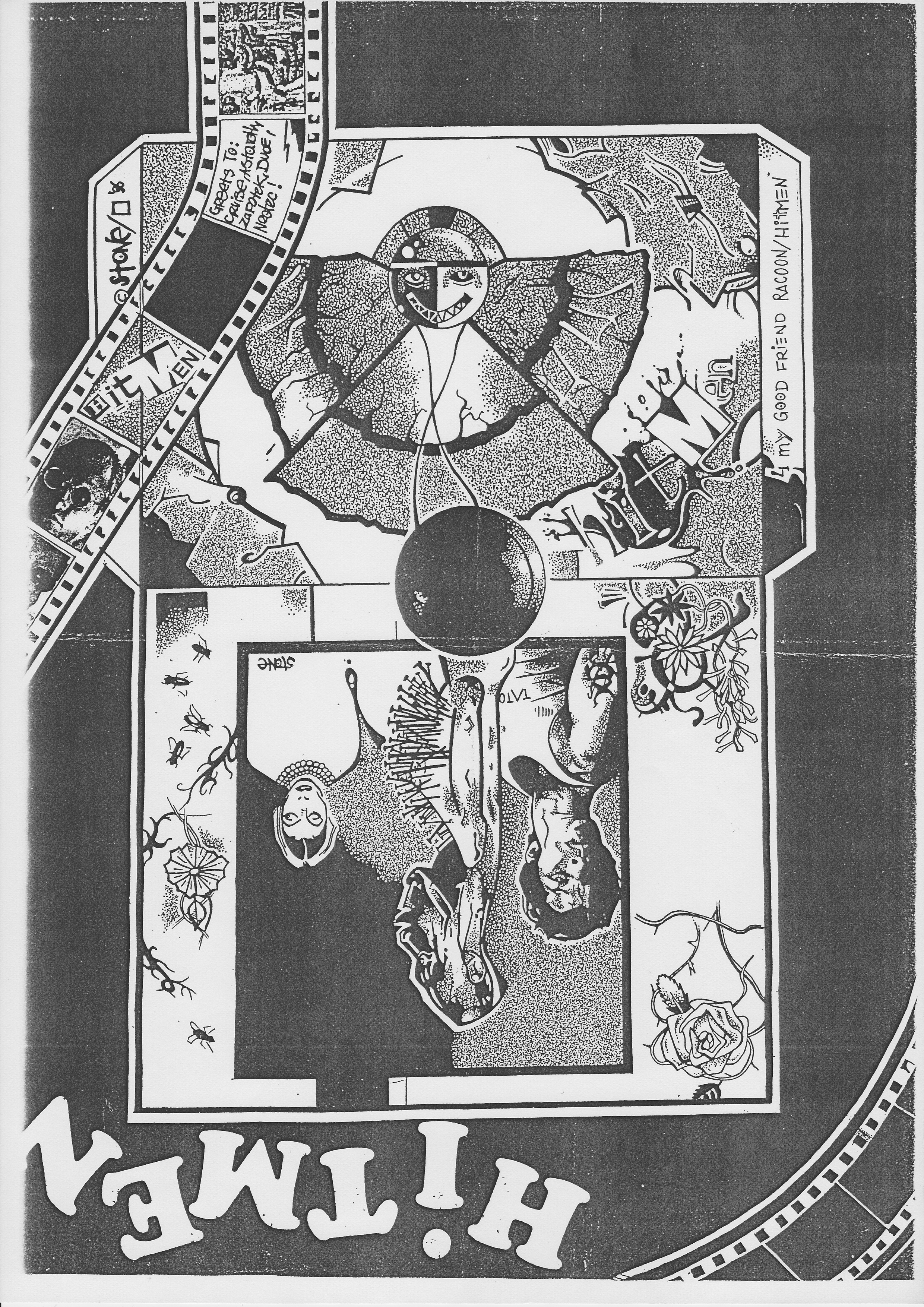
Hitmen disk cover by Stone, 1996 [metadata]
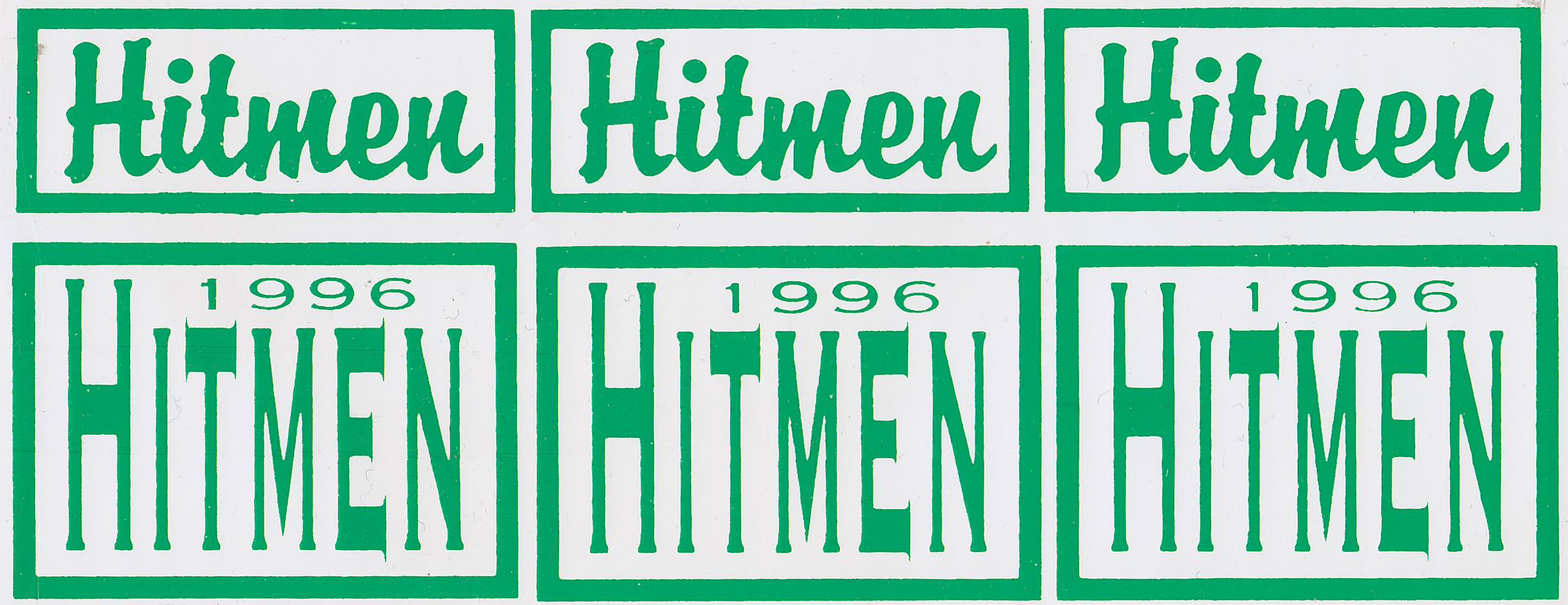
Hitmen sticker sheets, 1996 [metadata]
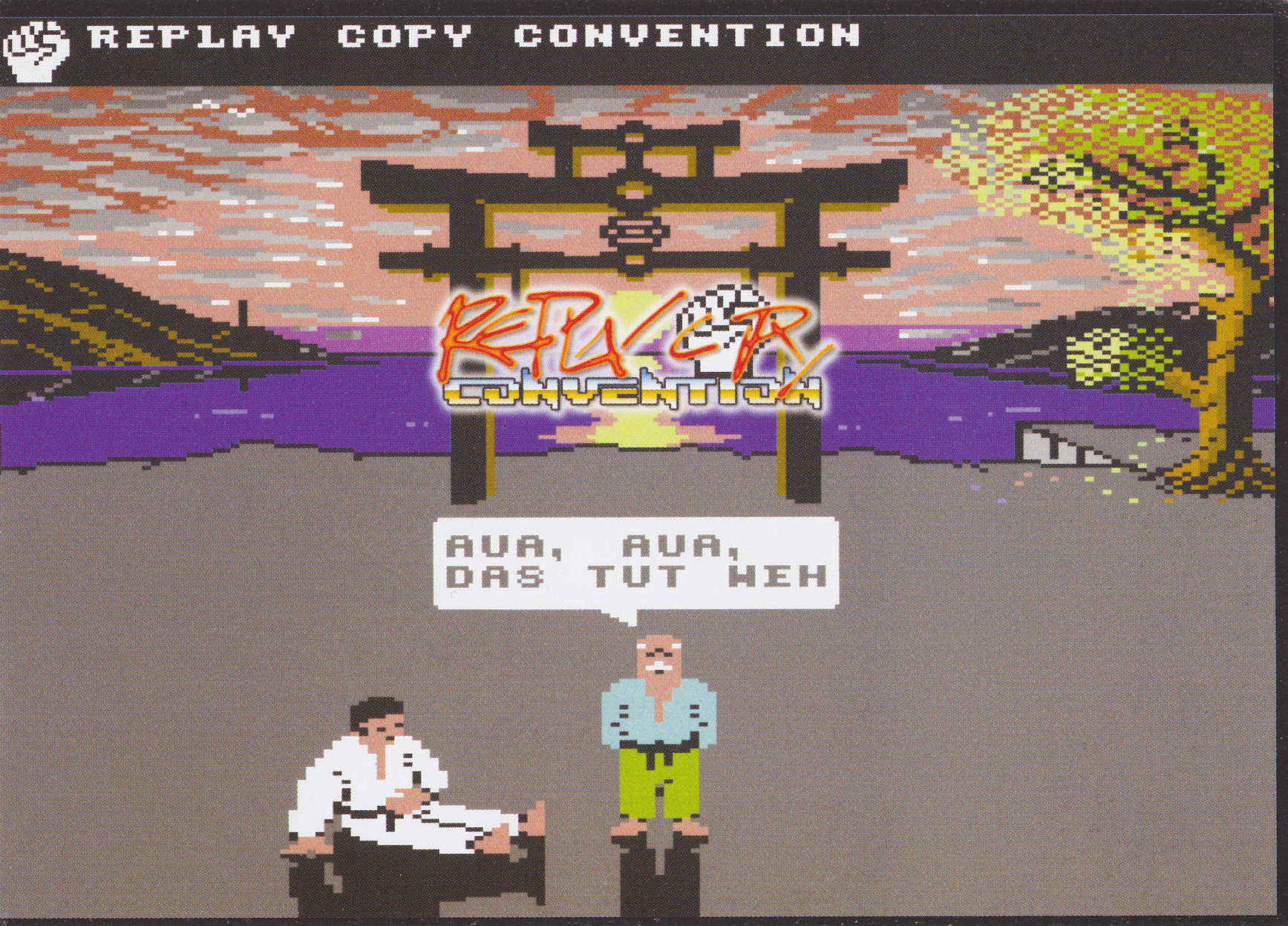
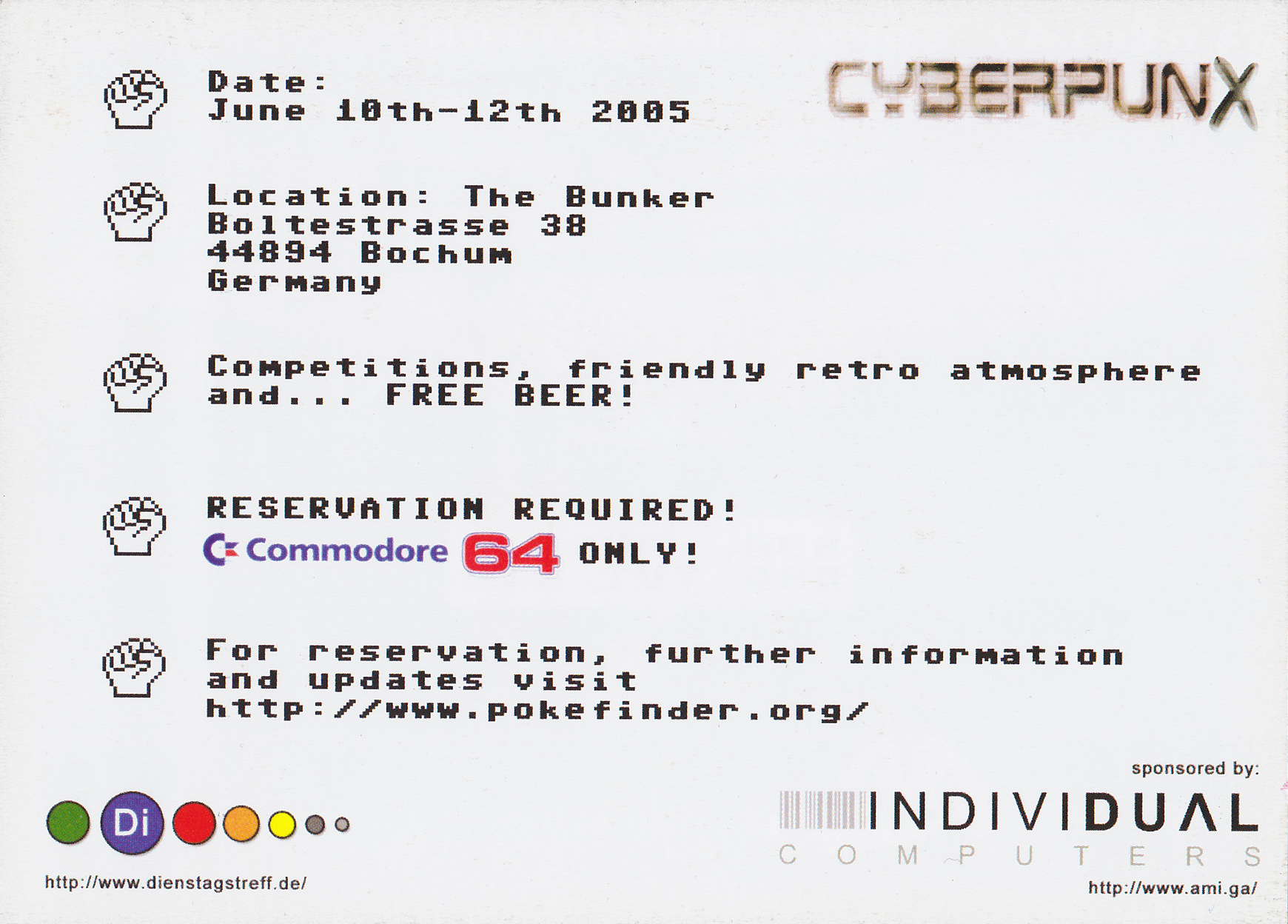
Replay Copy Convention 2005 flyer [metadata]
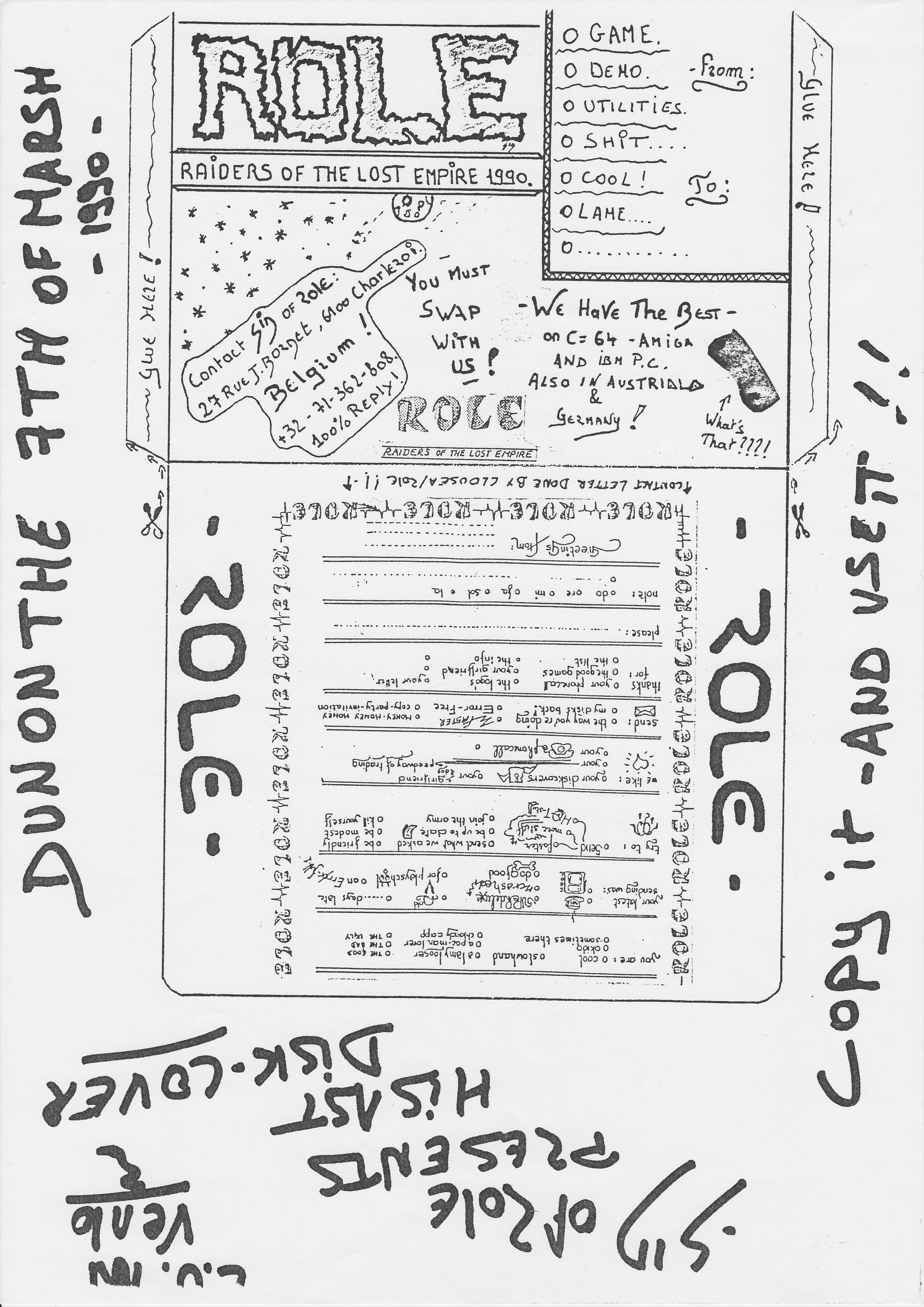
ROLE disk cover by SID, 1990 [metadata]

The PLK: A Crucial Communication Tool

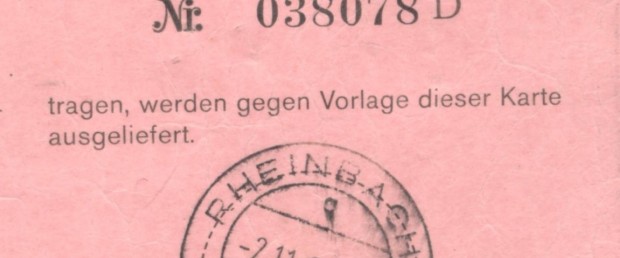
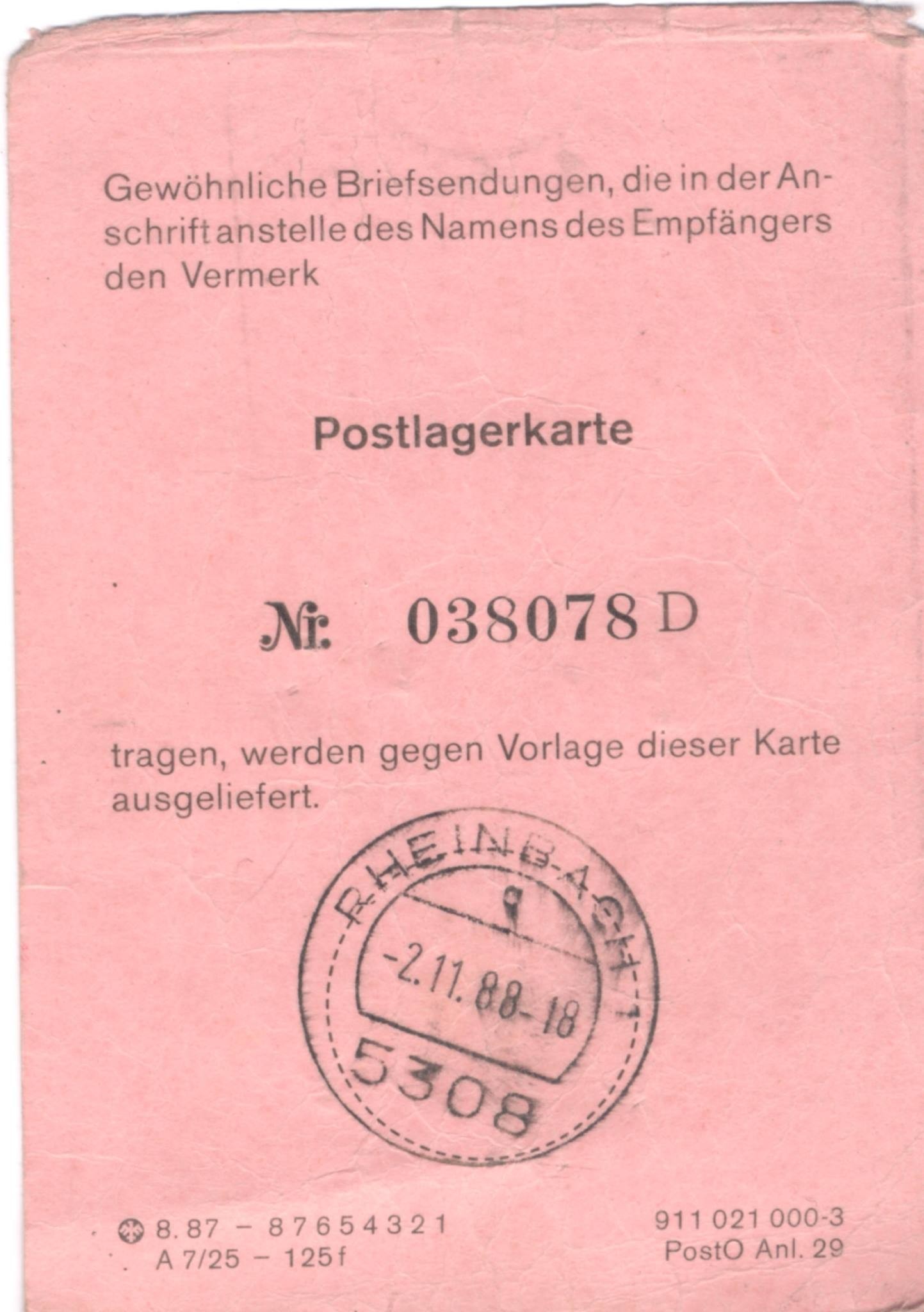
Bodo/Rabenauge provided us with this scan. It’s an inconspicuous pink paper slip, slightly bigger than a credit card. For German crackers and demosceners in the 1980s, however, it was the single most important tool for long-distance communication and data transfer, before the introduction of BBS‘s and a long time before the Internet.

PLK is short for “Postlagerkarte” and roughly translates as “Mail storage card”. Introduced by the German Imperial Post in 1910, it was a service that enabled customers to receive mail anonymously.7 The pink slip was the only ID you needed at the post office counter to pick up the mail sent to the particular PLK number. Also, unlike P.O. boxes (“Postfächer”), you could get a PLK for free and without having to reveal your identity.8 From the mid-1980s onwards, when German law enforcement began to take piracy more seriously, PLKs became the preferred software exchange channel for computer kids – and particularly for their “elite” segment, the crackers and swappers, who raised illicit software exchange to a semi-professional level. Going to the post office and picking up the latest disk-filled envelopes was part of the most active sceners’ daily routine. Some even went as far as having multiple PLKs across their hometown.9

Of course the German public, and particularly the law enforcement authorities, became aware of the scheme rather quickly. Already in 1984, some computer magazines stopped publishing classified ads with a PLK contact address, as it began to have an air of piracy and fraud around it.10 In 1986, the infamous copyright lawyer Günter von Gravenreuth described the PLK principle to a specialist audience.11 To cope with the PLKs’ anonymity, the authorities had to go to great lengths. After finding out which post office a particular PLK was assigned to, the police had to place plain clothes officers at the post office and wait until someone showed up to collect their mail.12 1980s cracker magazines are full of reports about people getting “busted” in this manner. Jeff Smart, editor of the papermag ‘Illegal’, described the typical situation in 1988: “Normally you get a PLK […] without giving your name or address, so the cops have to wait in the post office until you appear and get your packages from the counter clerk. Then they politely ask you: ‘are you really in that group X.X.X. ???’ and GA-BOSH! Game over for you!“.13 Such confrontations at the post office, which sometimes escalated into spectacular chasing scenes, could also lead to a house search.14

Those who used PLKs for swapping resorted to different strategies to counter these measures. After the dangers of picking up PLK mail became common knowledge, sceners went to the post office in groups: “One of us took a peek, and if the situation seemed safe, he beckoned the rest of us.”15 Those operating on a more professional level resorted to hiring younger kids who would pick up their mail for pocket money. These, ideally, did not even own home computers, and thus were perfectly “clean” when apprehended by the police.16 Other groups began leasing P.O. boxes in neighbouring countries with a more lax attitude towards piracy, such as Belgium or Luxembourg, and periodically drove over the border to pick up their packages.17

All in all, PLKs quickly turned out to be anything but the universal remedy for those involved in software swapping. However, they were still widely used – most importantly because they allowed the hiding of real names and addresses not only from the police, but also from other sceners. Thus, PLKs also became the preferred method of data exchange for demosceners – some of whom even wrote to commercial computer magazines arguing that having a PLK did not always imply criminal intent.18 The notion of a PLK as a synonym for a contact address within the scene became so popular that even in a Yugoslavian crack intro, the group introduced their contact details (an ordinary street address) as “our PLK”.19 Thus, the concept of a PLK gained international cultural significance within early home computer culture even beyond its original meaning.

The German Post abolished the PLK system on 1 June 1991. The scene did not shed many tears over it – after all, much of the data exchange was already relocated onto BBSs. However, a significant cultural practice disappeared, to be forgotten by all except by those who experienced it themselves.

Gleb J. Albert

Got a personal PLK story to tell, and want to share it with our readers? Please do get in contact!

PS: The scan of Bodo’s PLK is available here.